The recommended tire pressure for most passenger cars falls between 30 and 35 PSI, but the exact number for your vehicle is printed on a sticker inside the driver’s door jamb, not on the tire itself. That figure is set by the vehicle manufacturer to match the car’s weight and handling, and it’s the number you should check monthly. Here’s where to find it, why it matters, and how to keep your tires properly inflated through changing seasons.
Where to Find Your Car’s Recommended Tire Pressure
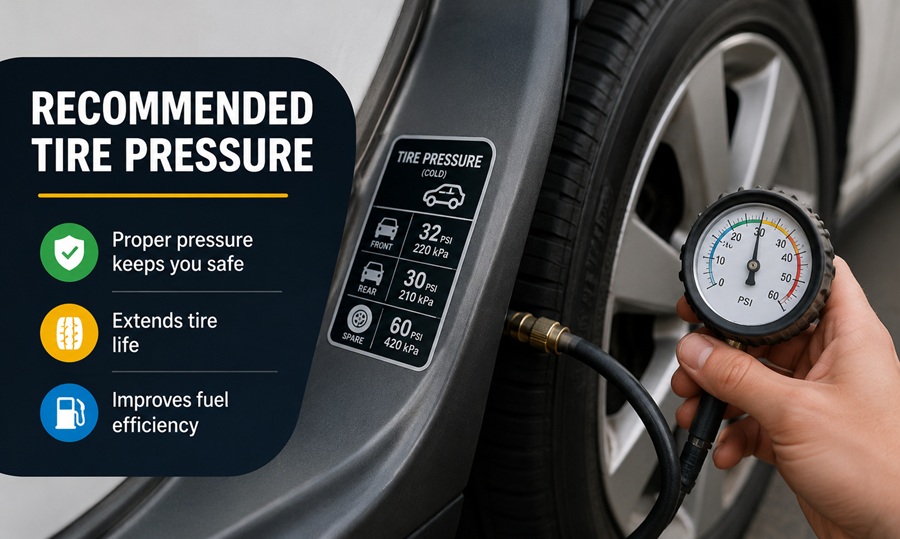
Open the driver’s side door and look at the door jamb — the vertical strip of metal you see when the door is open. A sticker there lists the recommended PSI for the front and rear tires, along with the spare if one is included.
This number is different from the maximum PSI printed on the tire’s sidewall. The sidewall number is the tire’s upper safety limit, not the pressure your car actually needs. Always follow the door jamb sticker or your owner’s manual, not the tire wall.
If the sticker has worn off or the car is a hand-me-down without the original manual, most manufacturers list the specification in the digital owner’s manual on their website, searchable by vehicle year, make, and model. Some dealership service departments will also confirm it for free.
Why Correct Tire Pressure Matters
Properly inflated tires affect three things at once: how the car handles, how much fuel it burns, and how evenly the tread wears. Underinflated tires flex more with each rotation, which builds up heat and increases the risk of a blowout on the highway.
Overinflated tires ride harder and wear out the center of the tread faster than the edges, shortening the tire’s lifespan. The U.S. Department of Transportation estimates that properly inflated tires can improve fuel economy by up to 3%, which adds up over a year of driving.
Handling is affected too. Underinflated tires make steering feel vague and increase stopping distance, especially in wet conditions, because less of the tread is making firm contact with the road in the way it was designed to. Overinflated tires reduce the size of the contact patch in a different way, which can make the car feel twitchy over bumps and uneven pavement.
Tire wear itself is one of the more expensive costs of ignoring pressure. A tire that wears unevenly because of chronic under- or overinflation may need replacement thousands of miles before a properly maintained tire would, turning a simple habit into a real cost difference over the life of a vehicle.
How Temperature Affects Tire Pressure
Tire pressure drops about 1 PSI for every 10°F drop in outside temperature. That means a tire sitting at 32 PSI in summer heat could read closer to 27 or 28 PSI on a cold winter morning, even without a leak.
This is why tire pressure warning lights tend to switch on during the first cold snap of the season. It’s not usually a sign of damage — it’s physics. Checking pressure at each seasonal change catches this drift before it becomes a handling or wear issue.
The reverse happens in summer. Hot pavement and rising air temperatures can push pressure several PSI above where it sat in spring, so a tire set correctly in April might read slightly high by August. Neither direction usually calls for a full deflate-and-refill — just a small adjustment back to the recommended number.
How to Check and Adjust Tire Pressure Correctly
Check pressure when tires are cold — meaning the car has been parked for at least three hours, or driven less than a mile. Driving heats the tires and raises the reading, giving you a falsely high number.
Remove the valve cap, press the gauge firmly onto the valve stem until the hissing stops, and read the number. If it’s below the recommended PSI, add air in short bursts, rechecking between each one. If it’s above, press the small pin inside the valve stem briefly to release air, then recheck.
Most gas stations have a coin- or app-operated air pump with a built-in gauge, but these are sometimes less accurate than a dedicated digital gauge kept in the glovebox. If you drive to the station, remember the tires will already be slightly warm, so aim a pound or two above the cold spec to compensate, then verify with a home gauge once the car has sat overnight.
Recommended PSI by Vehicle Type
| Vehicle Type | Typical Recommended PSI (Front/Rear) |
| Compact Sedan | 32 / 32 PSI |
| Mid-Size Sedan | 32 / 32 PSI |
| SUV / Crossover | 33 / 33 PSI |
| Pickup Truck (unloaded) | 35 / 35 PSI |
| Pickup Truck (towing/loaded) | 35 / 50-65 PSI (check manual) |
| Compact/Sports Car | 30 / 32 PSI |
These figures are general ranges for illustration. Your specific recommended pressure is always the number on your door jamb sticker, since it accounts for your exact tire size and vehicle weight distribution.
Front and rear pressures sometimes differ, especially on rear-wheel-drive and performance vehicles, where the manufacturer balances handling by specifying slightly different PSI for each axle. Trucks show the widest gap, since the rear pressure is often set much higher to handle towing or cargo loads, and should be reduced when the truck is driving unloaded to avoid a harsher ride and uneven center-tread wear.
Signs of Incorrect Tire Pressure
Underinflation often shows up as a car that feels sluggish to steer, uneven wear on the outer edges of the tread, or a tire that looks visibly bulged at the bottom. Overinflation tends to produce a stiffer, bouncier ride and wear concentrated in the center of the tread.
A tire pressure monitoring system (TPMS) light on the dashboard is the most direct signal, but it typically triggers only after pressure drops 25% or more below the recommended level — so a monthly manual check catches problems earlier than waiting for the warning light.
A tire that consistently loses pressure faster than the others, even after being topped off, is worth having inspected for a slow leak. Common causes include a small nail or screw in the tread, a corroded valve stem, or a wheel that’s slightly out of round from curb damage.
Choosing a Reliable Tire Pressure Gauge
Not all gauges are equally accurate. Pencil-style gauges are cheap and portable but can wear out and lose accuracy over a couple of years of use. Digital gauges tend to be more consistent and easier to read, especially in low light, though they run on a small battery that eventually needs replacing.
Dial gauges with a rotating face are a middle ground, often used by mechanics for their durability. Whichever type you choose, it’s worth comparing readings against a second gauge occasionally, since even a small calibration drift of 2 to 3 PSI can lead to consistently over- or under-inflated tires without you realizing it.
Frequently Asked Questions
Is the PSI number on the tire sidewall the one I should use?
No. The sidewall number is the tire’s maximum pressure rating, not the recommended pressure for your vehicle. Always use the number on the door jamb sticker or in the owner’s manual.
How often should I check my tire pressure?
Check tire pressure at least once a month and before any long road trip. Check more frequently during seasonal temperature swings, since pressure drops as the weather cools.
Can I use the gas station air pump instead of buying a gauge?
Gas station pumps work, but a personal digital gauge is more accurate and lets you check pressure at home without driving to a station first, which matters since tires should be checked cold.
Does tire pressure change with passenger load?
Yes. Many vehicles, especially trucks and SUVs, have separate recommended pressures for normal loads versus towing or full-passenger loads. Check the door jamb sticker, which often lists both.