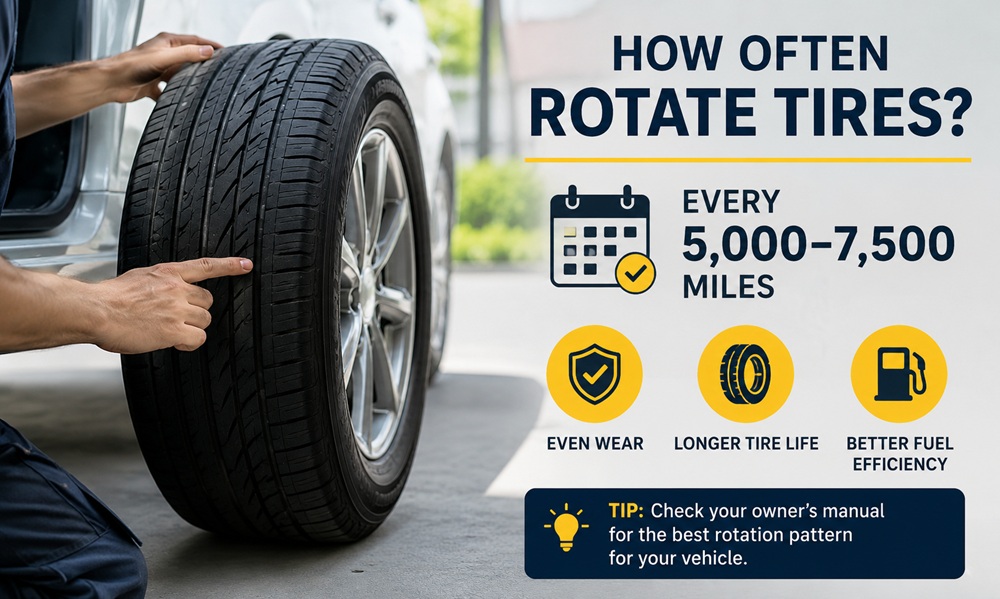
Most mechanics recommend rotating your tires every 5,000 to 7,500 miles, or roughly every other oil change. This keeps tread wear even across all four tires, helps your car handle predictably, and can add thousands of miles to the life of a tire set.
| Quick Answer Rotate your tires every 5,000-7,500 miles, or with every other oil change. All-wheel-drive vehicles should stay closer to the 5,000-mile mark since AWD systems wear mismatched tires faster. |
Signs Your Tires Need Rotation Now
- Noticeable vibration at highway speed
- Uneven tread depth between front and rear tires
- One side of the tread wearing faster than the other
- It’s been more than 7,500 miles since the last rotation
Any one of these on its own isn’t an emergency, but ignoring all four for too long usually means an early tire replacement.
Rotation Intervals by Vehicle Type
| Vehicle Type | Recommended Interval | Notes |
| Sedans and coupes (FWD) | Every 6,000-7,500 miles | Standard cross pattern |
| SUVs and crossovers (AWD) | Every 5,000-6,000 miles | AWD wears tires faster if mismatched |
| Trucks with heavy loads | Every 5,000 miles | Load weight accelerates wear |
| Performance cars, staggered wheels | Follow manufacturer guidance | Some can’t be cross-rotated |
Your owner’s manual will list the exact interval and pattern recommended for your specific car, and it’s worth checking since staggered setups sometimes can’t be rotated the same way as a standard set.
Why Front and Rear Tires Wear Differently
Front tires handle steering, braking, and most of the vehicle’s weight, so they tend to wear faster on the outer edges. Rear tires wear more evenly but can develop their own patterns over time. Left unchecked, this uneven wear shortens tire life, hurts fuel economy, and can make handling feel off in rain or snow. A shop in Phoenix that services a lot of pickup trucks put it simply: trucks that skip rotations often need new front tires a full year before the rears would have worn out.
What Is a Tire Rotation Pattern?
A rotation pattern determines which tire moves where. Front-wheel-drive cars typically use a forward cross pattern, moving rear tires straight forward and front tires diagonally to the back. Rear-wheel-drive and all-wheel-drive vehicles often use a rearward cross, doing the opposite. Directional tires, which have a one-way tread design, can only move front-to-back on the same side.
What a Rotation Actually Costs
Tire rotation typically costs between $20 and $50 at an independent shop, and many national tire retailers include free rotations with the purchase of a tire set. If you bought your tires from a chain store, check your paperwork first. That free service is easy to forget about, and skipping it can quietly void parts of your warranty.
Can You Rotate Tires Yourself?
Yes, if you have a jack, jack stands, and a torque wrench.
- Lift one corner of the car at a time using the jack, then secure it on a jack stand.
- Remove the wheel and set it aside according to your vehicle’s rotation pattern.
- Move each wheel to its new position, following the pattern for your drivetrain.
- Torque the lug nuts back to the manufacturer’s spec, listed in the owner’s manual or on a sticker inside the driver’s door.
If you’re not confident working under a car on jack stands, this is a job worth leaving to a shop.
Tips to Extend Tire Life
- Check tire pressure monthly, since underinflated tires wear faster and unevenly.
- Get an alignment check once a year or after hitting a significant pothole.
- Rotate tires on the same schedule every time, since consistency is what actually evens out wear.
- Run the penny test on each tire: insert a penny into the tread groove with Lincoln’s head down, and if you can see the top of his head, it’s time to shop for new tires.
Does Skipping Rotations Really Cost You More?
Skipping rotations entirely usually means the front tires on a front-wheel-drive car wear out noticeably faster than the rear set, sometimes needing replacement a full year or more before the rears would. Beyond the added cost of replacing tires in pairs rather than as a full set, uneven wear can also affect how the car handles in wet or snowy conditions, since worn front tires lose traction faster under braking. A driver in Minneapolis who skipped rotations for three years described replacing front tires twice before the original rear set ever needed attention, a clear example of how quickly the cost adds up when rotation gets skipped.
Staying on a consistent rotation schedule is a small habit that pays off in real dollars, safer handling, and one less unplanned trip to the tire shop.
Does Tire Rotation Affect Fuel Economy?
Yes, indirectly. Unevenly worn tires create more rolling resistance in some spots than others, which forces the engine to work slightly harder to maintain speed. Drivers who stay on schedule with rotations often report steadier fuel economy over the life of a tire set compared to those who let wear patterns go unchecked for tens of thousands of miles. It’s a small effect per mile, but it adds up the same way a slow leak in a tire quietly costs you at the pump long before the tire looks visibly low.