
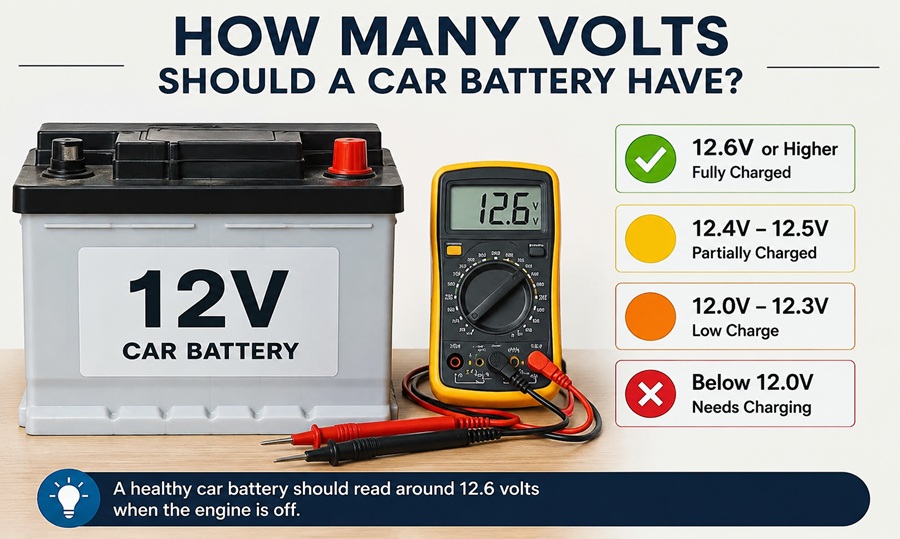
A healthy car battery reads 12.6 volts when the engine is off and between 13.7 and 14.7 volts while the engine is running. If your reading falls outside that range, the battery, alternator, or charging system may need attention. Anything below 12.4 volts at rest means the battery is partially discharged, and under 12 volts usually means it needs a charge or a replacement.
That’s the quick answer. Here’s what those numbers actually mean, how to test them yourself, and what to do if your voltage is off.
What Is a Normal Car Battery Voltage?
A standard 12-volt car battery doesn’t actually sit at exactly 12 volts when it’s fully charged — it sits closer to 12.6 volts. That extra fraction matters. A reading of 12.6V or higher means the battery is at or near full charge. A reading of 12.0V or lower usually means the battery is close to dead, even if the car still starts.
| Battery State | Voltage Reading | What It Means |
|---|---|---|
| Fully charged, engine off | 12.6V – 12.8V | Healthy |
| Engine off, moderate charge | 12.2V – 12.4V | Needs charging soon |
| Engine off, weak | Below 12.0V | Likely needs replacement or a full charge |
| Engine running | 13.7V – 14.7V | Alternator is charging properly |
| Engine running, low | Below 13.5V | Alternator may be undercharging |
| Engine running, high | Above 15V | Possible overcharging — get it checked |
Why Does Voltage Rise When the Engine Is Running?
Once the engine starts, the alternator takes over and charges the battery while also powering the car’s electrical system. This pushes voltage up to roughly 13.7–14.7 volts. If the reading doesn’t rise when you start the engine, the alternator likely isn’t charging the battery, which will eventually leave you stranded even if the battery itself is fine.
How to Test Car Battery Voltage at Home
You don’t need a mechanic to check this. A basic multimeter, available at any auto parts store for under $15, does the job in under five minutes.
- Turn off the engine and all accessories (lights, radio, AC) and let the car sit for at least 30 minutes if it was recently driven.
- Set the multimeter to DC volts, typically the 20V setting.
- Touch the red probe to the positive terminal and the black probe to the negative terminal.
- Read the number on the screen. This is your resting voltage.
- Start the engine and repeat the test. This is your running voltage.
If you don’t have a multimeter, many auto parts stores — including AutoZone and O’Reilly — will test your battery for free.
What Voltage Is Too Low for a Car Battery?
Anything below 12.0 volts at rest is considered too low for reliable starting. At 11.9 volts and below, the battery is roughly 25% charged or less, and cold weather makes the problem worse since low temperatures reduce a battery’s ability to deliver power. If your battery repeatedly drops below 12.0 volts even after charging, it’s usually a sign the battery is nearing the end of its life rather than just needing a top-off.
Should You Charge or Replace a Low-Voltage Battery?
This depends on the battery’s age and how it responds to charging.
- Charge it if the battery is under 3 years old, the voltage recovers after charging, and it holds that charge over a few days.
- Replace it if the battery is 4+ years old, won’t hold a charge overnight, or the reading stays under 12.2V even after a full charge cycle.
- Get it load-tested if you’re unsure — most auto parts stores offer this for free and it tells you the battery’s actual capacity, not just its voltage.
A battery can show a “normal” resting voltage and still fail a load test, especially in cold weather, so voltage alone isn’t the full picture — it’s a strong first checkpoint.
When Should You Check Your Car Battery Voltage?
A quick voltage check takes less than five minutes, so there’s no real reason to skip it. Good times to check include before a road trip, at the start of winter (cold weather is the top cause of battery failure), if the car has been sitting unused for more than a week, and any time you notice slow cranking when starting the engine.
Common Reasons for Unexpected Voltage Readings
A few situations throw off voltage readings and confuse people who are testing for the first time.
- Testing right after driving: Resting voltage needs the surface charge to settle. Wait at least 30 minutes after driving before testing at rest.
- Corroded terminals: Buildup on the terminals can produce inaccurate readings even with a good battery underneath. Clean terminals with a wire brush and a baking soda solution before testing.
- Parasitic drain: If voltage keeps dropping overnight even on a healthy battery, something may be pulling power while the car is off — a dome light, a bad relay, or an aftermarket accessory left connected.
- Extreme temperatures: Cold weather can drop voltage readings temporarily. This isn’t necessarily a battery problem; it’s chemistry. Batteries deliver less power in the cold.
Practical Takeaway
Voltage is the simplest, fastest way to gauge your car battery’s health. A reading of 12.6V at rest and 13.7–14.7V while running is the sweet spot. Anything consistently outside that range is worth a closer look before it turns into a no-start morning. Keep a cheap multimeter in the glove box — it’s one of the few tools that pays for itself the first time you use it.
Frequently Asked Questions
Is 12.2 volts too low for a car battery?
Yes, 12.2 volts indicates the battery is around 50% charged. It will likely still start the car but should be charged soon to avoid deeper discharge, which shortens battery life over time.
Can a car battery have too much voltage?
Yes. A running voltage consistently above 15 volts usually points to a faulty voltage regulator or alternator overcharging the battery, which can damage it and other electrical components. This should be checked by a mechanic.
Does cold weather affect car battery voltage?
Cold weather doesn’t change the resting voltage much, but it significantly reduces a battery’s ability to deliver current, which is why batteries that seemed fine in fall often struggle to start cars in freezing temperatures.